Guides
Part of Mobility friendly hotels comparison: three tiers, scored
8 steps for planning a mobility-friendly hotel stay without surprises
Eight steps from shortlist to check-out, including the one most travelers skip: asking where you would be moved if your accessible room fails mid-stay.
What to take away
- Shortlist three properties, not one. Accessible rooms sell while you deliberate.
- Ask what happens if the lift fails or your room becomes unusable mid-stay.
- Get the room configuration in writing, on paper as well as on a phone.
- Check the room against that confirmation before you unpack.
- Write two lines afterwardsroom number, bathroom layout, whether you would return.
The eight steps
Planning a mobility-friendly hotel stay comes down to eight steps, and they run in this order.
- Shortlist three properties, not one.Ask the same five questions of each before you commit to any of them.
- Get the bathroom photographs in writing.Six frames, named one at a time.
- Book the room, not the room type.Reserve the specific accessible configuration, and have the confirmation name it.
- Ask the failure question.Where you would be moved if the room or the lift fails mid-stay, and whether that room has the same bathroom.
- Pack for the room, not just the trip.Medication, documents, a flashlight, chargers, water, the equipment details, one bag you can grab.
- Confirm the week before.One call, four questions.
- Check the room against the written confirmation before you unpack.
- Write it down afterwards.Room number, bathroom layout, what differed, and whether you would return.
Why three candidates, not one
Accessible rooms are a small share of any property's inventory, and they go first. A single shortlisted hotel is a plan with no fallback.
Rank three, and put the same five questions to each:
Five questions for each hotel
- Bathroom layout
- Door widths
- Bed height
- Parking distance
- Date of last renovation
- Is the accessible room held for me by name, and what is its room number?
- What are the door widths, the bed height and the bathroom layout?
- Is there more than one accessible room, and can I be moved to it?
- What happens if the lift fails during my stay, and where would I be moved?
- Can you send the room details and the bathroom photographs in writing?
The answers sort the list faster than any review site.
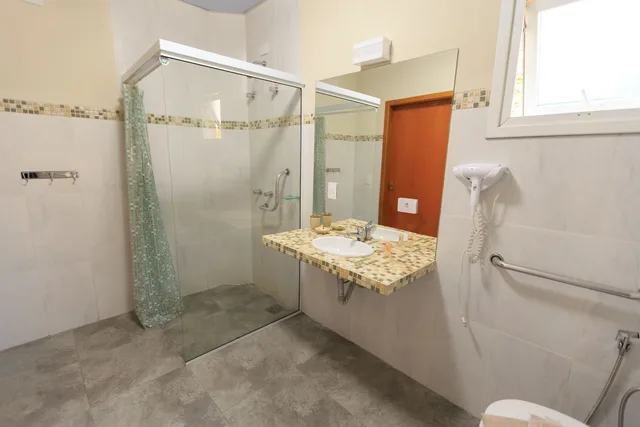
Ask for photographs of the bathroom specifically. Properties that keep them send them the same day. The six frames worth asking for are the six shots below. Ask for each by name:
- the doorway, with the clear width visible
- the whole room, shot from the doorway
- the toilet, with the grab bars and the transfer space beside it
- the shower, with the entry and any lip in view
- the controls, at seated height
- the sink, with the knee clearance underneath
Book the room, not the room type
Reserve the accessible room as a specific configuration and get written confirmation that names it. Use a refundable rate if the trip is far out.
Keep that confirmation where you can produce it at a desk. Paper, not only a phone, because a phone can be flat and a desk clerk cannot read a dead screen.
What the law backs you with
Hotels in the United States sit under Title III of the Americans with Disabilities Act, which the Department of Justice enforces, and the 2010 ADA Standards for Accessible Design set the numbers behind the questions above: door clear widths, grab bar placement, and the clear floor space beside a toilet or a shower.
The reservation rule, 28 CFR 36.302(e), requires a hotel to identify and describe its accessible rooms in enough detail for you to judge whether one meets your needs, to hold accessible rooms out of general sale until all other rooms of that type are taken, and to guarantee that the specific accessible room you reserved is the room you get. That guarantee is what the written confirmation with a room number is for.
Ask the failure question
This is the question almost nobody asks, and the answer tells you more than the room tour.
What happens if the lift fails during my stay, and where would I be moved if this room becomes unusable? Does the alternative have the same bathroom configuration?
Properties that answer without pausing have handled it before. The answer also reveals whether they hold more than one accessible room, which is the single most useful thing to know about a hotel.
Do your own side too. The federal emergency-preparedness guidance at Ready.gov on building an emergency kit travels well: medication, documents, a flashlight, chargers, water, the equipment details, one bag you can grab.
Confirm the week before
One call, four questions: is the room still held, is the lift working, is the accessible lobby restroom in service, and has any construction closed the accessible entrance.
Check before unpacking
On arrival, walk the room against the written confirmation before anything leaves a bag.
- Bathroomtoilet height, grab bar positions, shower entry and any lip
- Bed height against your transfer method
- Door widths on the room and the bathroom
- Route to the exit, including the accessible one
- Parking distance and the path between it and the door
If something is wrong, raise it at the desk with the confirmation in hand. Four in the afternoon is a far easier conversation than ten at night.
Write it down afterwards
Two minutes at the end of the stay, while it is fresh:
- property
- room number
- bathroom configuration
- what differed from the description
- whether you would book it again
Add the name of anyone who was genuinely helpful.
That note is the only accessible hotel database calibrated to your own requirements, and it turns the next booking into a ten-minute job. Over a few trips it becomes a personal directory of confirmed rooms along the routes you drive.
The park lodging variation
Inside a park, the same steps apply with longer lead times and a different failure plan, because the nearest alternative may be an hour away.
Book the accessible room as soon as the booking window opens, which can be a year ahead for lodges inside a park, and hold a refundable room outside the gate as the fallback. Book direct with the property itself rather than through a third-party site.
If the lift fails or the room becomes unusable, that outside room is the plan, not a promise from the desk.
Capitol Reef shows the planning burden clearly, and its accessibility information lists the facilities and services available where the alternatives are genuinely distant. The gateway town, Torrey, is where most of the nearby lodging sits.
Which properties deserve a place on the shortlist is covered in which hotels make sense, and what the whole thing costs is mostly settled at the shortlisting stage.
What you pay comes down to three choices: a refundable rate or a non-refundable one, one room or a second held as insurance, and how far the nearest alternative sits. Ask the property to put the refundable premium and the deposit it requires in writing, next to the room details you already asked for.
Common questions
How far ahead should I start?
Three months for popular destinations, six weeks elsewhere, longer for lodging inside a national park. The constraint is not the hotel's calendar but how fast the accessible rooms go.
Is it worth booking two hotels as insurance?
Some travelers do, on critical trips, using refundable rates on both. It costs one night's deposit to hold a fallback, which is cheap against a trip that fails on arrival.
What if the property will not confirm in writing?
Book elsewhere. A property that will not put the configuration in writing will not remember it at check-in either.
Should I tell them I will check the room?
No need. Just do it, courteously, before unpacking. Staff who know the room is being checked tend to have checked it themselves.