Costs
Part of Mobility friendly hotels comparison: three tiers, scored
Mobility friendly hotels: ADA booking rules, no surcharge
Mobility friendly hotels: what the ADA reservation and surcharge rules require of a hotel, and which booking habits protect you from paying for the wrong room.
What to take away
- An accessible room is normally priced as its room type, not as a premium product.
- Scarcity, not the room, is the costbook late and the only accessible room left is in the top category.
- Parking, resort fees and the card hold are the three lines that turn a quoted rate into a bill.
- A refundable rate is usually cheaper than one night in a room you cannot use.
- Ask the property, not the platform. Access requests get lost in third-party bookings.
Mobility friendly hotels cost the same as an equivalent standard room: the room type sets the rate, and access does not add a premium. Budgeting is ordinary hotel budgeting with two differences. The stock is thin, and a wrong room costs the whole night rather than some comfort.
The accessible room is not a premium product
In most properties the accessible room carries the rate of its room type, the same as an equivalent standard room. Properties that say so on the booking page save everybody an email.
What costs money is scarcity. Book late and the only accessible room left is in the expensive category, or there is none and you are paying for a different hotel entirely.
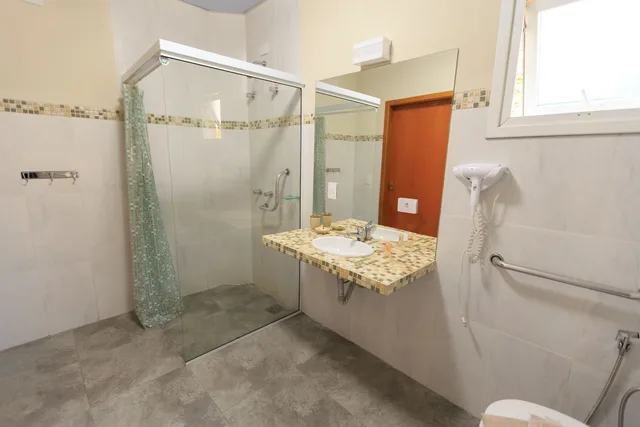
Access is regulated, so it is not a line the hotel is free to price. Title III of the Americans with Disabilities Act requires hotels to provide the features set out in the 2010 ADA Standards for Accessible Design: roll-in showers or tubs with seats, grab bars, clear floor space and reachable controls. The Department of Justice enforces that, and none of it sets a room rate.
The reservation rule at 28 CFR 36.302(e) governs how accessible rooms must be described and held, which is why a property can be held to what it advertises. It applies to reservations made by any means, including by telephone, in person or through a third party. A hotel must:
- let you reserve accessible rooms during the same hours and in the same manner as other guests;
- identify and describe the accessible features of its rooms in enough detail for you to judge independently whether a room meets your needs;
- hold accessible rooms for guests with disabilities until all other rooms of that type have been rented;
- block the room you reserve and remove it from all reservations systems;
- guarantee that the specific accessible room you reserved is held for you.
A separate rule, 28 CFR 36.301(c), says a public accommodation may not impose a surcharge on individuals with disabilities to cover the costs of measures the law requires, such as barrier removal or reasonable modifications in policies.
Benchmarking a quote
The General Services Administration's lodging pages explain how government travelers book accommodation and the rate framework behind it. GSA also publishes per diem lodging rates by fiscal year and locality, which gives you an outside view of what a reasonable mid-market rate looks like in a given area.
You are not booking on those terms. Look up the rate for your destination and the current fiscal year before you compare quotes; the number is still a sanity check against a quote that looks high.
Three lines that inflate a rate
- Parking.In city centers this can approach the room rate, and accessible parking on site is sometimes charged as a separate item.
- Resort and facility fees.Added at the property, frequently absent from the search result.
- The card hold.Not a charge, but it ties up money for days.
Ask for the all-in total across all three before comparing two properties.
Book direct
Third-party platforms are where access requests disappear. The room type transmits; the specific requirements often do not.
Book with the property, get written confirmation, and if a platform rate is materially cheaper, ask the property to match it in the same conversation that notes the access requirement.
The Consumer Financial Protection Bureau, which supervises credit card issuers, answers common consumer finance questions, the background to sorting out an incorrect charge after a stay. Under the Fair Credit Billing Act you can dispute a billing error on a card, and a hold is released by your card issuer rather than by the hotel.
Where to spend more
The refundable rate, always, where the trip depends on this room. Treated as a line item rather than an upgrade, it is the cheapest insurance on the trip.
Where extra spend pays off
Worth paying
- Refundable rate
- Cheapest trip insurance
- Closer property
- Avoids two taxis daily
- Second night
- Halves check-ins and verification
What it buys
- Refundable rate
- Closer property
- Second night
The closer property, when the alternative is two taxis a day.
The second night, which halves the check-ins and the verification work.
When the wrong room is booked
A traveler books the cheapest accessible room in a small town for one night in season, non-refundable, without asking for measurements. The bathroom turns out to have no roll-in shower.
The night is paid for and unused. The replacement, if one exists at short notice, is at walk-up rates. The next morning goes to sorting it out.
That asymmetry is why the refundable rate and the written confirmation earn their cost. Booking the cheapest available accessible room without verifying it is the expensive choice.
Where to spend less
Room quality above the level you need. Breakfast packages. Anything upstream of the actual constraint, which is the bathroom.
Which properties are worth this is settled room by room and by what the property confirms in writing, not by the brand; which hotels make sense is a question of verified measurements on the room you will actually get. The planning steps are mostly timing: two to three months ahead for popular destinations, earlier if you need a specific room type rather than whatever is left.
Common questions
Do hotels ever charge more for an accessible room?
They should not. The ADA rules bar a surcharge for measures the law requires. If a property does charge more, ask why in writing and consider booking elsewhere. A rate difference attached to the accessible room is a signal about how the property treats access.
Is a package deal ever worth it?
Rarely. The access request tends to get lost between the airline, the hotel and whoever assembled the package. You end up confirming the room yourself anyway, having paid for the bundle.
What if the price rises after I ask about accessibility?
Ask for the original quote in writing and escalate to the property's manager. A rate that moves once access enters the conversation is not normal practice.
How far ahead should I book to get a fair rate?
Two to three months for popular destinations. Availability matters more than the rate, because a fair rate on a room you cannot use is not a saving.