Reviews
Part of Mobility friendly hotels comparison: three tiers, scored
Mobility-friendly hotels: how to compare them by location
A mobility-friendly hotels comparison that starts with what is reachable in fifteen minutes: the chains, in-park lodges and airport properties to weigh.
What to take away
- Compare mobility-friendly hotels on what is reachable in fifteen minutes without a transfer, not on star rating.
- Embassy Suites, Hyatt House and Residence Inn run all-suite layouts, which shorten the walk from bedroom to kitchen to lobby.
- Grand Canyon Lodges inside the park and Yavapai Lodge remove a daily drive that runs an hour or more each way.
- Airport properties such as the Grand Hyatt at DFW and the Hilton Boston Logan are built for a two-night trip with one objective.
- Ask for doorway width, turning radius and bed height in writing before you book.
Where an accessible room is scarce, the trip gets built around it. That flips the comparison: not hotel against hotel, but the trip each one makes possible. Four chains and properties below show how the axis changes the answer.
All-suite chains shorten the indoor walk
What it is
- Embassy Suites by Hilton
- All-suite, two rooms, cooked-to-order breakfast
- Hyatt House
- Suite layouts with full kitchens, wide corridors
- Residence Inn by Marriott
- Apartment-style suites, grocery delivery
- Hampton Inn
- Standard rooms, consistent footprint
- Grand Canyon Lodges
- In-park rooms at the South Rim
Who it suits
- Embassy Suites by Hilton
- Longer stays, travelers who need space to turn a chair
- Hyatt House
- Trips of four nights or more
- Residence Inn by Marriott
- Families and longer stays
- Hampton Inn
- Short trips where predictability matters
- Grand Canyon Lodges
- Park trips where the drive is the problem
Pricing model
- Embassy Suites by Hilton
- Nightly rate, varies by city
- Hyatt House
- Nightly rate
- Residence Inn by Marriott
- Nightly rate
- Hampton Inn
- Nightly rate
- Grand Canyon Lodges
- Nightly rate, books out months ahead
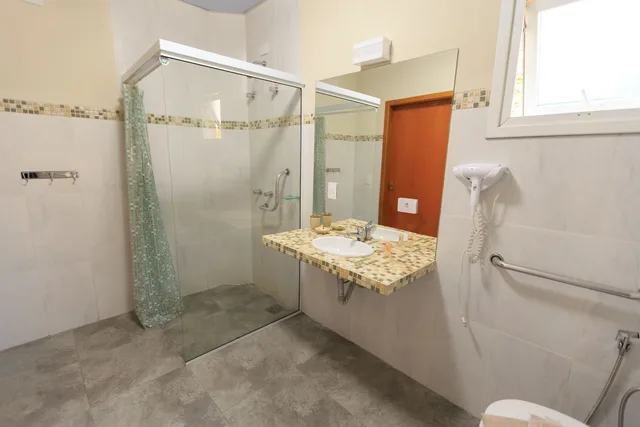
The suite chains matter because the bedroom-to-bathroom-to-kitchen path is shorter than a corridor walk. Door clear width and turning space are set by the ADA Standards for Accessible Design, so the numbers exist for any accessible room; ask each property for door width, turning radius and bed height for the exact room, in writing. The front desk has the access sheet, and a chain that will not send it is telling you something.
Chains that publish their numbers
Embassy Suites
- What it is
- All-suite, two rooms
- Who it suits
- Longer stays, space to turn
- Pricing model
- Nightly rate
Hyatt House
- What it is
- Suites, full kitchens
- Who it suits
- Trips of four nights or more
- Pricing model
- Nightly rate
Residence Inn
- What it is
- Apartment-style suites
- Who it suits
- Families and longer stays
- Pricing model
- Nightly rate
Hampton Inn
- What it is
- Standard rooms
- Who it suits
- Short trips, predictability
- Pricing model
- Nightly rate
Airport hotels are a strategy, not a fallback
For a short trip built around flying, staying at the airport is a real answer. Modern terminals have level paths, accessible shuttles and no transfer on the morning of the flight. Airline access is governed by the Air Carrier Access Act, which the Department of Transportation enforces under 14 CFR Part 382; the FAA's air travelers page covers the flight side, and the airport end is where delays and long distances concentrate.
The Grand Hyatt at Dallas Fort Worth sits inside Terminal D. The Hilton Boston Logan connects to the terminals by covered walkway. For two nights and one attraction, either beats a downtown room plus two airport transfers, especially when the chair is handed over at the gate.
Inside the park against a gateway town
At the Grand Canyon, the choice is South Rim lodging or a hotel in Tusayan, Williams or Flagstaff. The park's lodging page lists what exists inside, and staying in removes an hour or more of daily driving plus the parking problem.
Bright Angel Lodge and El Tovar sit in Grand Canyon Village, and Yavapai Lodge sits beside Market Plaza; all three are inside the park and on the South Rim shuttle network, which runs the Village (Blue), Kaibab Rim (Orange) and Hermits Rest (Red) routes. Ask which stop serves your room before you book. Accessible rooms inside parks are the scarcest lodging in the country, so book them the day the window opens.
Run one day through both properties
When two candidates look equal, write out a realistic day for each:
- breakfast
- the anchor attraction
- lunch
- an afternoon stop
- dinner Count the transfers and the total distance on foot or wheels.
One property nearly always produces two fewer transfers. That is the answer, and it takes fifteen minutes. Three is the right number to shortlist, since accessible rooms sell while you deliberate.
What not to compare on
Star ratings, breakfast quality, decor. None of them decides whether the trip works.
Once the shortlist is set, the stops worth building around a good base turn a room into an itinerary, and which properties make sense for a longer stay is the next decision.
Common questions
The questions that decide most trips once the room is the constraint.
Is a resort ever the right answer?
Where everything sits on one site and internal transport exists, yes. Check the internal distances first, because they are frequently large.
How do I judge a district for accessibility?
Street imagery shows curbs and grade. Then call the hotel and ask which way they send guests on foot.
What if the best-located hotel has no accessible room?
Then it is not the best located. The room is the constraint the trip is built on, and everything else follows from it.
Ask for the access sheet in writing, then book the day the reservation window opens; those two moves decide more trips than any brand comparison.