
Features
Part of Mobility friendly hotels comparison: three tiers, scored
Plan a US road trip around mobility friendly hotels options
Mobility friendly hotels options decide where a long US road trip stops. How to choose the corridor, confirm the room and space the driving between beds.
What to take away
- In remote regions the gap between usable rooms can be several hours. Map it before committing.
- Two nights per stop wherever possible. One-night stops are where the failures cluster.
- Keep one flexible night in the middle as the shock absorber.
A long trip is a chain of rooms with driving between them, and mobility friendly hotels options are what decide where the stops fall. Where accessible rooms are scarce, the chain determines the route rather than the other way round. Driving keeps the chair with you the whole way, which is most of why long American trips are driven rather than flown.
Book the rooms, then draw the line
Identify where confirmed accessible rooms exist along the corridor you want, then design the driving around them.
Rooms First, Route Second
- Identify confirmed accessible rooms
- Map the corridor you want
- Design driving around those rooms
- Avoid a four-hour gap with nowhere to sleep
Doing it in the other order produces a beautiful route with a four-hour gap in the middle and nowhere to sleep.
A worked corridor is Interstate 40, from Flagstaff, Arizona to Albuquerque, New Mexico:
Book the rooms
- 58milesFlagstaff to Winslow, about , roughly an hour
- 120milesWinslow to Gallup, about , roughly one hour fifty
- 60milesGallup to Grants, about , roughly an hour
- 78milesGrants to Albuquerque, about , roughly one hour ten
Each town has chain hotels with published accessible room types, but nothing is confirmed until you call.
Chain hotels and budget motels
US hotels and motels built or altered since the 1991 ADA standards took effect must include accessible guest rooms. The rules are the ADA Standards for Accessible Design, enforced under Title III of the Americans with Disabilities Act, and they require the accessible rooms to be spread among the different room types a property offers. The required count rises with the size of the property, so a 30-room motel may hold one or two where a 300-room hotel holds many more.
Large chains publish accessible room details for each property: Marriott, Hilton, Hyatt, IHG brands such as Holiday Inn, Choice brands such as Comfort Inn, and Best Western.
Property type matters as much as brand. Budget motels include Motel 6, Super 8, Days Inn and Econo Lodge. With either group, the brand only tells you where to look; which room types exist at that specific property is what you confirm by phone.
Confirm the room
- Call the property, not the national booking line.
- Ask which rooms are accessible, and ask for the room numbers.
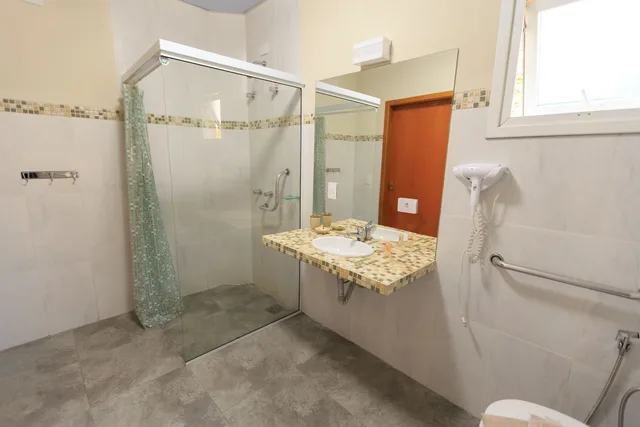
- Ask for the door width, the bathroom turning space and the shower type.
- Ask the hotel to email the confirmation with the room number and room type.
- Call again two days before arrival and confirm the same room.
Remote country needs extra care
In sparsely populated regions the gaps are long and the options are few.
Remote Country Room Check
- Canyonlandsdistricts spread out, little between them
- Mojavevery large area, limited facilities
- Distance between services is the constraint
- Confirm rooms at each end first
- Then commit to the middle
Canyonlands is a good illustration of the problem, and its accessibility information makes clear how spread out the districts are and how little sits between them.
Island in the Sky is about 32 miles from Moab, Utah, roughly 45 minutes. The Needles district is about 75 miles from Moab, roughly an hour and a half. Moab is the nearest base with a choice of hotels.
The Mojave presents the same challenge in a different form, and its accessibility pages cover a very large area with limited facilities, where distance between services is the defining constraint.
Baker sits at the north edge of the preserve, about 62 miles from Barstow, roughly an hour. Kelso Depot is about 35 miles south of Baker, roughly 40 minutes.
The nearest hotels are in Barstow and in Needles, about 145 miles apart on Interstate 40, so a day inside the preserve runs from one of those towns.
Two nights per stop
One-night stops mean checking in, verifying a room, sleeping and leaving. Any problem with the room becomes a crisis because you are leaving in the morning anyway.
Two nights gives you a day to use the base, time to resolve a room problem, and half the check-ins over the trip.
The flexible night
Keep one night in the middle of the trip booked on a refundable rate with no plans attached.
It absorbs a slow day, a bad room, a weather closure or a repair. Trips with a shock absorber survive; trips booked tight do not.
What makes a stop worth adding
- A confirmed accessible room, in writing
- Somewhere to eat within reach without a transfer
- One thing worth seeing, ideally free
- A pharmacy or supermarket within a short drive
- A route in that avoids the worst of the terrain
Keep a running list
After each stop, write one line: property, room configuration, what was right, what was wrong, and whether you would return. A set of room photographs with a tape measure in them turns that line into something another traveler can use.
Share the good ones. Confirmed accessible accommodation is the scarcest information in this whole subject.
What to skip
The famous town with no accessible rooms. The scenic detour that adds two hours between beds. The one-night stop that exists only to break up a drive.
For which specific properties to look for, see which hotels make sense, and comparing the trips different bases enable is the same exercise at the scale of a single stop.