Guides
Part of A budgeting checklist for accessible travel that skips fuzzy averages
What an accessible weekend trip costs with one hotel base and free Access Pass entry at Arches and Canyonlands
A two-night accessible trip on one hotel base, with figures for room, fuel, meals and entry, plus free Access Pass entry at Arches and Canyonlands.
What to take away
- The America the Beautiful Access Pass is free for eligible people. It covers entry at Arches, Canyonlands and Carlsbad Caverns. Mail orders add a $10 processing fee.
- One hotel for two nights beats two hotels for one night each. You get one check-in and one bathroom to verify.
- For one base, pair Arches and Canyonlands from Moab, Utah. Carlsbad Caverns is the indoor day when weather threatens.
- Ask the hotel for door width, bed height and bathroom turning space before you book. A listing that says accessible and publishes no numbers is a gamble.
- Fuel, meals and the room are the whole cost. Budget a refundable rate and one taxi if a transfer is hard.
- Two people, two nights, pass collected in person$440 to $690, covering fuel, meals and the room.
- The Moab anchors publish access details in advance. The day is planned, not discovered on arrival.
The free federal anchors: Arches, Canyonlands and Carlsbad Caverns
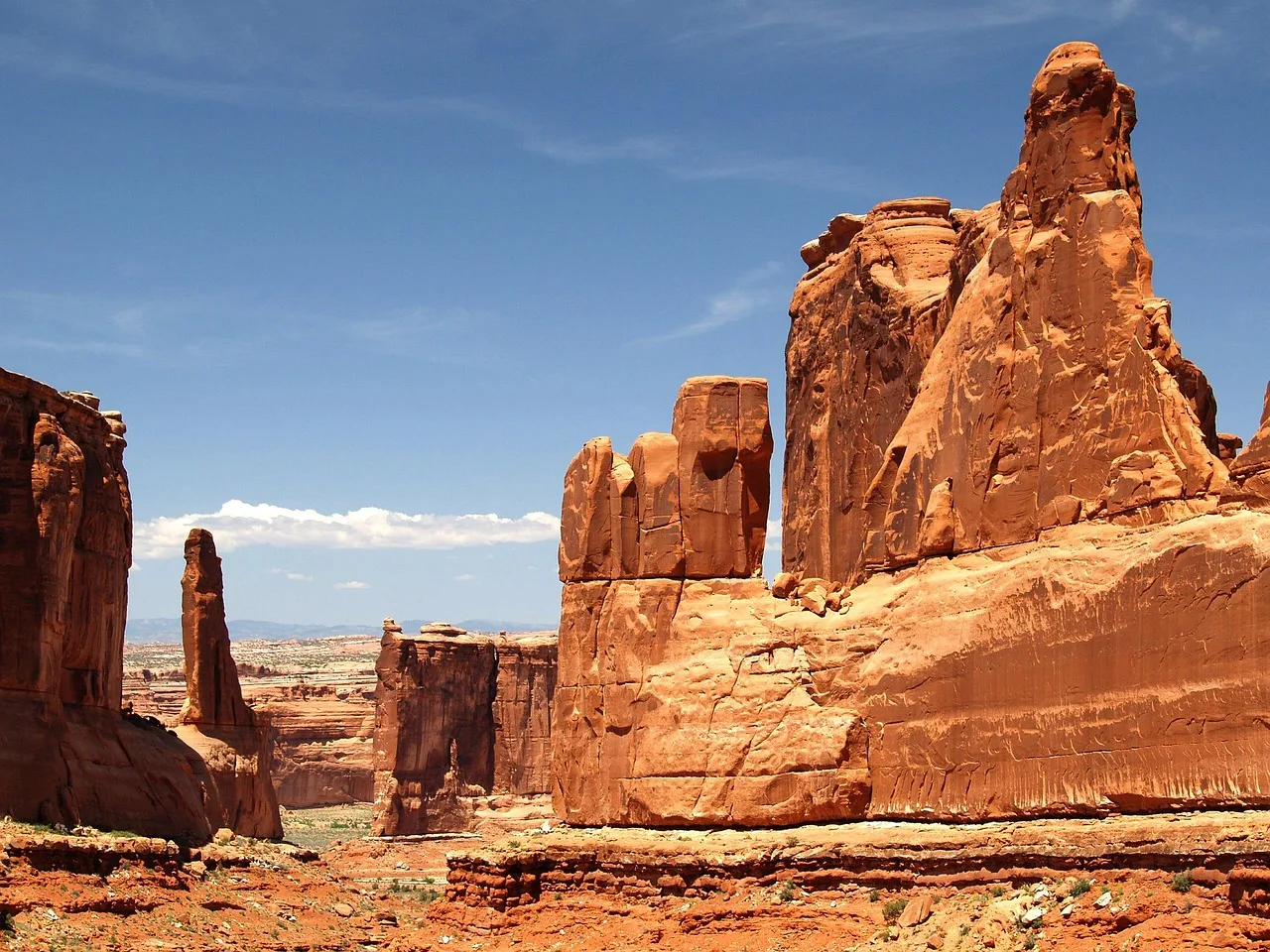
Arches National Park runs its main sights off a scenic drive with parking at each stop. The Arches accessibility page lists which viewpoints and trails work and where the accessible parking sits. Arrive early, because those bays fill first. Arches charges $30 per vehicle without the Access Pass. The pass covers that entry fee.
Canyonlands National Park, 30 miles from Moab, has paved overlooks on the Island in the Sky district. The Access Pass covers its $30 per vehicle entry. Together with Arches, it gives you two free federal anchors from one Moab hotel base.
Carlsbad Caverns gives you a day the weather cannot touch. The Carlsbad Caverns accessibility page explains lift access, the surfaces inside and which sections are reachable. Read it before you book the tour, not after. Standard entry is $15 per adult without the pass. Ranger-guided tours cost extra and the pass does not cover them.
Entry at all three is covered by the Access Pass where you hold one. The pass is free for eligible people, with a $10 processing fee if you order it by post instead of picking it up in person.
What the weekend costs
Figures below are illustrative and current as of publication, not live quotes. Park entry fees are published rates and hotel rates move with season. Substitute your own.
| Line | Illustrative figure | What drives it |
|---|---|---|
| Hotel, 2 nights | $110 to $180 a night in Carlsbad, New Mexico; $150 to $250 in Moab, Utah | Season, distance from the park gate, refundable versus prepaid |
| Fuel | $60 to $90 | Round-trip miles divided by your vehicle's mpg, times the pump price |
| Meals, 2 people | $120 to $180 | Two lunches, two dinners, one sit-down |
| Park entry | $0 with the Access Pass | Without it, Arches and Canyonlands charge $30 per vehicle each; Carlsbad Caverns charges $15 per adult |
| Access Pass | $0 in person; $10 by mail | Covers entry, not Carlsbad Caverns tour fees |
| Taxi or transfer | $30 to $60 | Only if a hard transfer needs removing |
| Total, 2 people, pass in person | $440 to $690 | Add $10 if you mail the pass |
The room is the line that moves most. A refundable rate costs more than a prepaid one and buys you the right to cancel if the accessible room turns out to be wrong.
Choosing the base
One hotel, two nights, on a level route to the parking. Mid-range chains near the park, and accessible campsites inside it, are where that room is cheapest without being a gamble. In Moab, look at Hampton Inn, Holiday Inn Express and La Quinta. In Carlsbad, New Mexico, check Best Western, Comfort Inn and La Quinta.
All publish accessible room details on request. Ask for the door clear width and the turning space before you hold the room.
Ask for numbers, not adjectives. In the ADA standards, door clear width is at least 32 inches (81 cm), and bathroom turning space is a 60 inch (152 cm) circle or a T-shaped turn.
Clear floor space beside the bed should be 30 by 48 inches (76 by 122 cm). Bed height has no fixed standard, so ask for the mattress top in inches.
Where the saving goes
Put the admissions money into the things that protect the days:
- A taxi that removes a hard transfer
- The refundable rate on the room
- A closer parking bay where one is chargeable
- A proper sit-down lunch rather than a rushed one
Variations
No car. Substitute a city with light rail and two free museums, a shape that removes the adapted vehicle and the parking together. The Smithsonian museums are free, and Metro stations have elevators.
Bad weather. Move the indoor day first and hold the outdoor day for the better forecast.
More time. Add a third day at a wildlife refuge rather than driving further.
The method behind the numbers is in budgeting without fuzzy numbers. For what goes wrong on the cheap version specifically, read the first-visit tips.
Common questions
Is the Access Pass really free?
Yes, for eligible people. There is a $10 processing fee if you order it by post rather than collecting it in person. It covers entry at federal sites, which is why both anchors in this plan cost nothing to enter. It does not cover Carlsbad Caverns tour fees.
Are the cheap days worse days?
No. Federal sites publish better access information than most paid attractions. That detail is what makes them the better days, not the price.
What if there is no park within range?
Substitute a city with free museums and light rail. The structure is the same.
Can this work in one day?
Yes, and the second night is what makes it restful rather than a long drive with stops. Drop the second night and the fuel and fatigue lines both rise.