Reviews
Reading travel mobility equipment with a sceptical eye
Six categories of travel mobility equipment compared on fit, transport, batteries and repairability, with the federal battery rules that decide.
What to take away
- Folding weight is the first number in every review and the last one that decides whether a trip works.
- For air travel the battery governs more than the frame. The watt hour limits are published, and your airline can be stricter.
- Repairability beats sophistication once you are five hundred miles from your supplier.
- A device that fits badly at home fits worse after eight hours in an airport.
- Four numbers separate a real review from a photograph with adjectives: seat width, seat-to-floor height, battery watt hours, turning radius.
This is a desk review of categories, not a test of products. No manufacturer supplied equipment or saw this before publication. Nothing here is a prescription. Anything touching seating, pressure, transfers, breathing or medication belongs with your own clinician and supplier.
The six categories, and what each one costs you
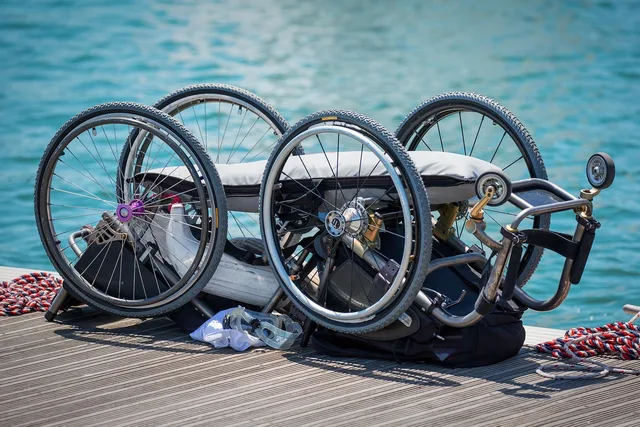
Manual folding chair. Lightest, cheapest to fly, hardest on shoulders over distance. A travel version of a chair you already trust usually beats a new model.
Rigid manual chair with quick-release wheels. More efficient to push and stronger in a crash test than most folding frames. Awkward in a car boot.
Power add-on for a manual chair. Adds range without adding a second device. Adds a battery, which is where the flying rules begin.
Folding power chair. Convenient in a car, usually compromised on seating, and the category where reviews are least reliable.
Full power chair. Best seating and control, hardest to fly with, and the one where damage in the hold matters most.
Mobility scooter. Comfortable over long distances, poor in tight indoor spaces, and often the wrong tool for a museum day.
The battery rules, which are specific
Battery limits are the part of equipment reviewing where guesswork gets expensive, so read the source rather than a forum.
FAA lithium battery limits
- 300 Whmax installed battery
- 1 spareup to 300 Wh
- 2 sparesup to 160 Wh each
- Cabinspares carried here
The Federal Aviation Administration's guidance for airline passengers and batteries limits the lithium ion battery in a wheelchair or mobility device to 300 watt hours. You must tell the airline where the battery is. Lithium metal batteries are forbidden in these devices.
Spares are covered too. At most one spare not exceeding 300 watt hours, or two spares not exceeding 160 watt hours each, carried in the cabin rather than the hold. A device with the battery installed and protected by design is checked rather than carried on.
Your airline may be stricter. Read the watt hour rating printed on your own battery before you book anything.
What screening adds
Screening is a separate process from carriage, with its own rules for medical items.
TSA publishes a category list for medical items giving the carry-on and checked answer for canes, casts, external medical devices and blood sugar kits. The officer at the checkpoint makes the final decision, so print the entries that apply to you.
Where an operator is arranging the trip, confirm which part of the airport step is theirs and which stays yours.
How to judge a review you did not write
How to judge a review
- Does it give a seat width and a seat-to-floor height, or only a folded weight?
- Does it name the battery fitted and its watt hour rating?
- Does it give the turning radius, which decides indoor use?
- Does it say what broke and how long the replacement part took to arrive?
A review missing those four is a photograph with adjectives attached. The last one is why two repair contacts near the destination belong in the plan twelve weeks out.
Where quotes diverge
Accessible tour operators price four lines differently, and the spread explains most of the gap between two quotes for the same trip.
- Vehicle and lift. A wheelchair-accessible van with a driver costs more per day than a standard car, and the premium is the line most often left off a first quote.
- Attendant hours. Whether a guide stays for the whole day or hands over at the door changes the total more than the hotel does.
- Ticket handling. Some operators buy timed-entry tickets in advance and some leave that to you.
- Cancellation terms. A quote with generous refunds is priced for the risk.
Ask for those four lines in writing before you compare totals. Operators who build trips around equipment are covered in the sixteen kinds of tour company, and comparing trip types shows how far the choice of device narrows the destinations that work.
Choosing between categories
Start with the seating, then the transport method, then the battery, then the weight. Reversing that order is how people end up with a light device they cannot sit in.
Hotel rooms sold as accessible vary by jurisdiction, and the numbers behind the label are set by state and local building codes rather than one national figure. California and New York publish their own. Ask the property for door width, bed height and bathroom turning radius in inches, and treat a listing without numbers as unverified.
Common questions
Is a travel chair worth owning as a second device?
If you fly more than twice a year, often yes. It protects the chair you live in and takes the handling damage instead.
Should I rent at the destination instead?
For scooters, often. For a chair you sit in all day, rarely, because seating is the part rental fleets cannot match to your body.
How do I find my battery's watt hour rating?
It is normally marked on the battery case. If it is not, ask the manufacturer rather than estimating, because the airline will check the printed figure.
What is the most common trip-ending failure?
A damaged castor or a bent axle from hold handling. Carry the parts that are cheap and small, and confirm the repair path with the device manufacturer or a certified technician before you fly.
In this guide
- Travel mobility equipment time: annual service and testsPlan travel mobility equipment time with an annual service, a practical pre-trip test, and seasonal checks for batteries, tires, brakes, and chargers.
- Travel Mobility Equipment Packing List for Air TravelUse this travel mobility equipment packing list to prepare device documents, protect batteries, carry repair parts and hand over equipment for air travel.
- Travel mobility equipment under review: the good, the weak and the verdictA working review of travel mobility equipment names the models worth buying, the scooters and wheelchairs to avoid, and how to judge a device before you pay.
- How to vet mobility equipment repairers before a tripHow to find and vet fitting, rental and repair contacts for travel mobility equipment near a destination, which questions to ask and what Medicare covers.
- Keeping a travel mobility device working for the whole tripFive ways to move a travel mobility device to your destination, each with its real cost, its failure mode, and the battery check that keeps it working.