Rules
What the ADA requires at hotels, attractions and transit in the U.S
Wheelchair-accessible travel in the U.S. runs on ADA Title III rules for hotels, attractions and transit. Here is what each covers and how to complain.
What to take away
- Wheelchair-accessible travel in the United States rests on one federal law, ADA Title III, which covers hotels, ticketed attractions and most transit as public accommodations or specified transportation services.
- The 2010 ADA Standards for Accessible Design set the numbersdoor clear widths, grab bar positions, aisle widths, lift dimensions and the count of accessible guest rooms.
- Ticketed venues must sell companion seats beside wheelchair spaces, keep accessible routes open and remove barriers when removal is readily achievable.
- Fixed-route buses and rail cars follow the Access Board's ADAAG for Transportation Vehicles, not the building standards.
- Federal sites such as national parks fall under the Architectural Barriers Act, not Title III.
- Complaints go through the ADA Information Line or ADA.gov, and the DOJ case record shows hotels and venues are frequent targets.
How ADA Title III splits hotels, attractions and transit into different rule sets
ADA Title III is the part of the Americans with Disabilities Act that governs places of public accommodation and certain transportation. Hotels, restaurants, theaters, stadiums and museums are public accommodations.
The full text of ADA Title III regulations sets out the duties, and the rules differ by what the facility is and who owns it.
A hotel is a public accommodation with lodging-specific rules. A ticketed attraction is a public accommodation with seating and route rules. A city bus is neither: fixed-route transit is covered by Title II if the operator is a public entity, and by Title III if it is private.
That split matters because the standards, deadlines and complaint routes change with it.
Private entities that offer exams, courses or travel packages can also fall under Title III. So can a private shuttle that serves a hotel or a theme park. The test is whether the entity is a public accommodation or a specified transportation provider, not whether it calls itself a business.
Two duties cut across all of these settings. A public accommodation cannot charge extra for an accessibility feature, such as a lift or a hearing loop. It also must allow service animals and communicate with customers who are deaf or hard of hearing.
Access also varies by region, so see Accessible U.S. travel for how the rules play out from state to state.
What the 2010 ADA Standards actually measure in a guest room and a lobby
The 2010 ADA Standards for Accessible Design are the measurements that turn accessible into something you can verify. They apply to new construction and alterations, and to barrier removal in existing buildings to the extent required.
Guest room vs lobby standards
Guest room
- Entry
- clear door width
- Bathroom
- grab bars, roll-in shower
- Controls
- switch and outlet heights
- Counter
- not specified
- Seating
- not specified
- Alarms
- visual alarms
Lobby
- Entry
- accessible route
- Bathroom
- not specified
- Controls
- not specified
- Counter
- accessible registration counter
- Seating
- accessible seating
- Alarms
- not specified
In a guest room, the standards address door clear width, maneuvering space at the bed, control heights and grab bars. They also cover roll-in showers in a portion of accessible rooms, plus visual alarms.
The standards give the numbers. A guest room door must give at least 32 inches of clear width when the door is open 90 degrees.
Grab bars sit 33 to 36 inches above the finished floor with 1.5 inches of clearance from the wall, and the bar beside a toilet is at least 42 inches long. Turning space inside the room follows a 60 inch circle, or a T shape with 60 inch arms and a 36 inch stem.
Roll-in showers are required in a portion of the accessible rooms, and the count rises with the property's room total. Ask the hotel how many it has and on which floors, because the label alone does not tell you.
The count of accessible rooms also scales with the property size.
Accessible guest room count
| Total guest rooms | Rooms with mobility features |
|---|---|
| 1 to 25 | 1 |
| 26 to 50 | 2 |
| 51 to 75 | 3 |
| 76 to 100 | 4 |
| 101 to 150 | 5 |
| 151 to 200 | 6 |
| 201 to 300 | 7 |
| 301 to 400 | 8 |
| 401 to 500 | 9 |
| 501 to 1,000 | 2 percent of rooms |
| Over 1,000 | 20 plus 1 per 100 over 1,000 |
A lobby must have an accessible route from the entrance, an accessible registration counter or an equivalent, and accessible seating. Those three items come up often in DOJ settlements.
A registration counter must have a section no higher than 36 inches above the floor, with an accessible route to it.
Accessible guest rooms are not one category. The standards require a mix: rooms with mobility features, rooms with communication features, and rooms with both. A property with many rooms must spread them across room types, not cluster them all in one wing.
What the Standards address
- Guest room entry
- Clear door width and maneuvering clearance
- Bathroom
- Grab bars, shower type, turning space
- Controls
- Switch and outlet heights, thermostat reach
- Lobby
- Accessible route, registration counter, seating
- Communication
- Visual alarms, notification devices
When a listing says accessible room, ask which features it has. Confirming an accessible U.S. hotel room before you travel means getting the measurements in writing, not a verbal assurance.
Ticketed attractions: companion seats, routes and readily achievable limits
Ticketed attractions include theaters, stadiums, concert halls, museums and theme parks. Under Title III they must provide accessible seating with companion seats, accessible routes to the seats and to amenities, and accessible restrooms. They must also make reasonable modifications to policies, such as allowing a service animal or a personal care attendant.
Companion seating is a specific requirement. At least one companion seat must be adjacent to each wheelchair space, and it must be sold at the same price and at the same time as the wheelchair space. Venues cannot force a companion to sit elsewhere or pay a premium.
Existing venues do not have to rebuild everything at once. Barrier removal is required only when it is readily achievable, meaning easy to accomplish without much difficulty or expense. That is a lower bar than the new construction standard, and it is why older theaters and ballparks can still have gaps.
Practical tests appear in the details. A pool lift, an assistive listening receiver and a level route from the parking lot are common gaps at older venues. Ask about each one when you book. For a deeper look at what to ask before you buy, see access details to check.
The limits show up in historic buildings and in venues with steep, fixed seating. A venue may be unable to make every seat accessible, but it still must offer an accessible route, an accessible seat with a companion option, and accessible facilities.
Transit under the ADA: fixed-route buses, rail cars and vehicle rules
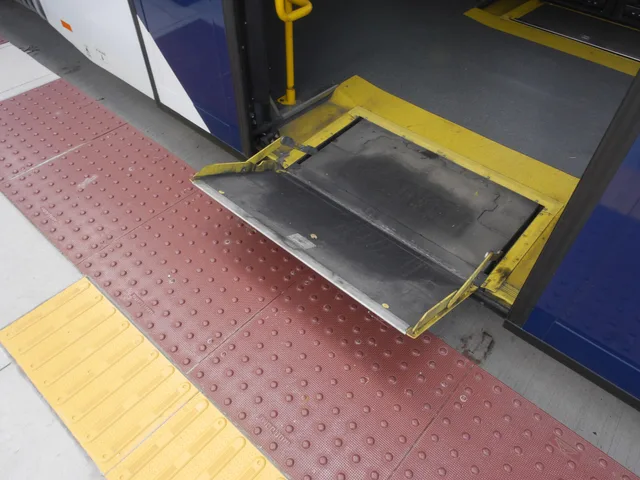
Transit accessibility in the United States is split between Title II, for public transit agencies, and Title III, for private providers. The technical rules for the vehicles themselves come from the Access Board, not from the building standards. The ADAAG for Transportation Vehicles covers buses, vans and rail cars.
Under those rules, new fixed-route buses must be lift- or ramp-equipped and have securement positions for wheelchairs. Rail cars must have accessible doorways, interior circulation and securement areas.
The vehicle guideline sets a 32 inch minimum clear width for doorways and requires a clear path, including aisles, to the securement area.
Transit agencies must also provide complementary paratransit for trips that fixed-route service cannot make accessible. That is a separate service with its own eligibility process, and it is not a substitute for fixing the fixed route.
Paratransit eligibility follows federal tests. A rider qualifies if they cannot board, ride or leave a fixed-route vehicle without help. A rider also qualifies if the vehicle on their route is not accessible, or if an impairment keeps them from reaching the stop.
Apply through the transit agency's paratransit office, which may ask for a form from a health care provider and an interview.
The agency must decide in writing within 21 days of a complete application. If it misses that date, the applicant counts as eligible until a decision is made.
Trips are booked in advance, commonly one day ahead, and service runs on the same days and hours as the fixed route.
Amtrak operates under its own accessibility rules and offers assistance for boarding and detraining at staffed stations. Air travel is covered by a different law, the Air Carrier Access Act, and the Department of Transportation publishes an Air Travel Consumer Report on disability complaints.
Where the Architectural Barriers Act picks up at federal sites and national parks
The Architectural Barriers Act, or ABA, applies to facilities designed, built, altered or leased with federal funds. That includes national parks, federal buildings, post offices and many courthouses. The ABA standards applied to federally funded facilities such as national parks are published by the Access Board.
The ABA is older than the ADA, dating to 1968, and it covers federal and federally funded facilities rather than private businesses. The National Park Service applies ABA standards to visitor centers, restrooms, trails and campgrounds, and publishes accessibility guides for individual parks.
The standards overlap with the ADA in their technical content, but the enforcement route differs. ABA complaints go to the Access Board, which forwards them to the responsible federal agency. That is a different path from a Title III complaint against a hotel.
For a traveler, the ABA matters at the places people most often visit on a national trip: park visitor centers, historic structures, and federal museums. If a facility is federally funded, ABA standards are the ones to cite, not Title III.
The distinction can be confusing at a park with private concessions. The federal buildings fall under the ABA, while a privately run lodge or gift shop may fall under Title III. Ask which entity operates the facility before you cite a standard.
DOJ enforcement: what the case record shows about hotels and venues
The U.S. Department of Justice enforces Title III through investigations, settlement agreements and lawsuits. The DOJ case record shows recurring problems at hotels and venues: inaccessible pools, missing accessible rooms, blocked routes and inaccessible seating.
Named cases make those patterns concrete. A DOJ consent decree with Hilton Worldwide required the chain to change how accessible rooms are described and booked, with staff training and room surveys.
In 2008 a federal appeals court ruled against AMC Entertainment in a case about stadium-style theater seating and wheelchair sight lines. A DOJ consent decree with Uber Technologies addressed wait time fees charged to riders who need more time to board.
Hotel cases often involve reservation systems that do not identify accessible rooms accurately, or properties that treat a single accessible room as sufficient. Settlement agreements typically require staff training, room surveys and changes to booking systems.
Venue cases often involve companion seating and ticketing. The DOJ has required venues to sell companion seats at the same price and to make accessible seats available through the same sales channels as other seats.
Enforcement is not only about lawsuits. The DOJ also issues guidance and technical assistance letters, and it can open a compliance review without a complaint. A pattern of complaints can trigger an investigation of a chain rather than a single property.
The case record is worth reading before a trip because it shows what the DOJ treats as a violation, not just what the statute says. It is also a reminder that many fixes happen after a complaint, not before.
How to file a complaint through the ADA Information Line and ADA.gov
The ADA Information Line is the first stop for questions and for routing, and it explains how travelers verify requirements and file complaints.
The toll-free voice number is 800-514-0301, staffed weekdays in Eastern time, typically 9:30 a.m. to 5:30 p.m. The TTY number and the current schedule are posted on the Information Line page.
You can also file online through ADA.gov. A Title III complaint goes to the DOJ, while a transit complaint may go to the Federal Transit Administration. An ABA complaint goes to the Access Board. The complaint form is at https://www.ada.gov/file-a-complaint/.
Filing a Title III complaint
- Write down what happened, where, when, who
- Identify the barrierramp, route, seat, room
- Gather evidencephotos, emails, reservation records
- Contact ADA Information Line or file via ADA.gov
- Keep a copy and note the response
Checklist before you travel:
- Confirm companion seating and its price at the same time you buy your ticket.
- Check whether the transit leg is fixed-route, paratransit or rail, and what assistance is offered.
- For a federal site, ask whether ABA standards apply and request the park accessibility guide.
- Save the ADA Information Line number and the ADA.gov complaint page.
- Note the date, time and name of anyone you speak with.
Keep the details in writing, because a file built on written measurements, not promises is the kind that holds up in a complaint.
State codes layered on top of federal rules: what travelers still must verify
States and cities can adopt codes that go beyond the ADA, and some do. California, New York, Florida and Massachusetts have their own accessibility requirements for buildings, and some cover hotels and attractions more strictly than federal law.
A state code can require more accessible rooms, different signage or additional features. It can also set a different complaint route through a state civil rights agency. Federal law sets a floor, not a ceiling.
That means a property can be fully compliant with the 2010 Standards and still fall short of a state or local code. It also means a property can be out of compliance with a state code while meeting the federal minimum.
For travelers, the practical advice is to verify both. Ask what the state code requires, and ask the property for the measurements. As a general rule, measurements matter more than the word accessible in any listing.