Rules
Wheelchair-Accessible Travel: Planning a Flight in the U.S.
Wheelchair-accessible travel by air takes planning: request airline assistance, prepare for TSA screening, protect your chair, and document damage if it occurs.
What to take away
- Wheelchair-accessible travel by air takes planning around airline assistance, wheelchair stowage and airport connections.
- Ask how your mobility device will be handled and returned, and document its condition before and after each flight.
- The Air Travel Consumer Report's disability section provides complaint-rate information to consider when comparing carriers.
- TSA Cares can help coordinate screening assistance in advance, but standard screening procedures still apply.
- Document damage promptly and contact the airline; damage during TSA screening follows a separate claims route.
- Photos, a baggage report and repair estimates help create a record if a chair is damaged.
Airline assistance, wheelchair stowage and handling
For wheelchair-accessible travel, the practical questions include what help is available, how a mobility device is handled, and what happens if it is damaged. The rules for air travel with disabilities are set by the Air Carrier Access Act (ACAA) and its implementing regulation, 14 CFR Part 382.
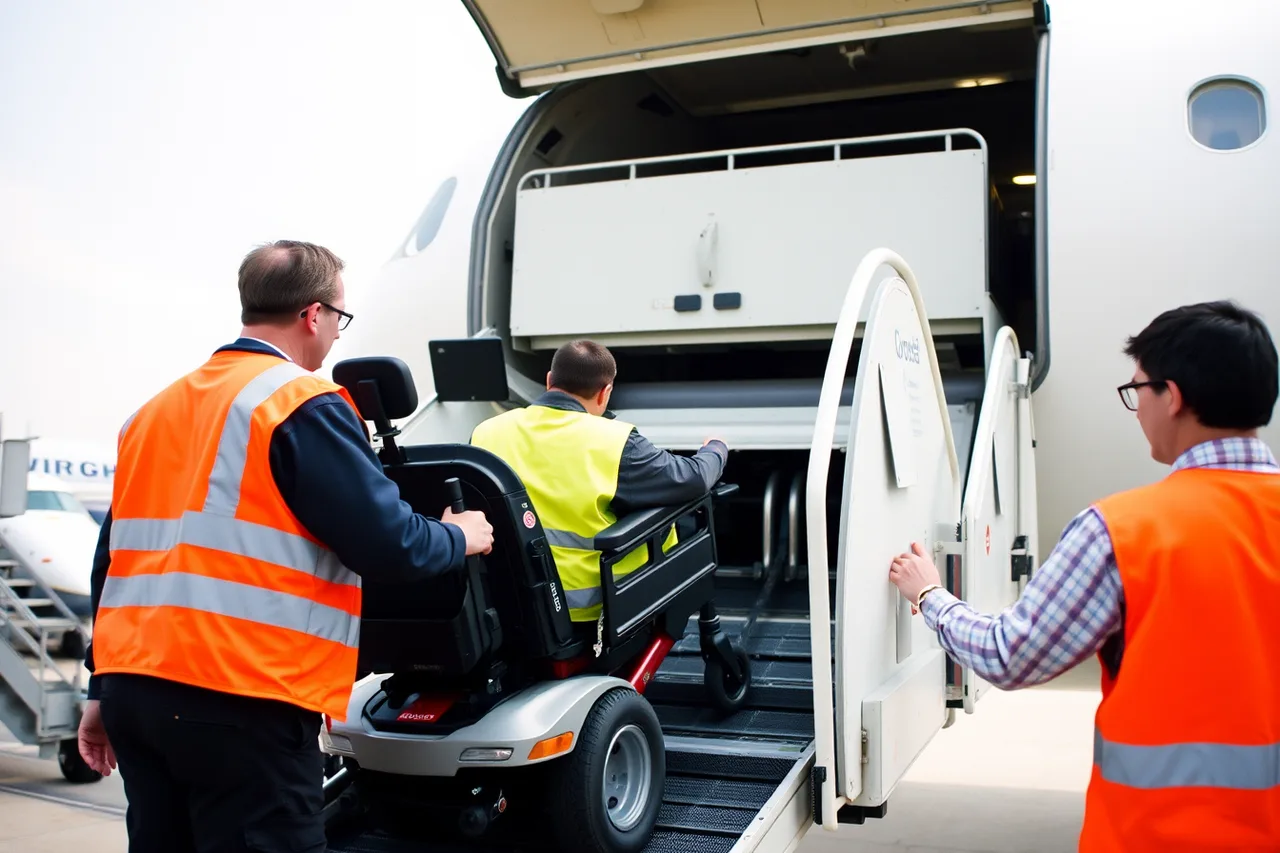
Airlines must provide enplaning, deplaning and connecting assistance. They must let you stay in your own wheelchair until the boarding door, wherever the aircraft and jet bridge allow it. They must return your mobility device promptly at the gate on arrival, not at baggage claim, on aircraft with a cargo hold that can take it.
The Disability | US Department of Transportation page collects these obligations, including the treatment of wheelchairs as checked baggage and the liability that follows.
You cannot be charged for the carriage of a wheelchair or other assistive device on a domestic flight. If the device is damaged, destroyed, lost or delayed, the carrier is liable. Under 14 CFR Part 382, a carrier's liability limit for a mobility device cannot be less than its original purchase price; the ordinary checked-baggage liability cap does not apply.
Stowage is where most damage happens. Gate-checked wheelchairs are loaded by hand into the hold, and a power chair with a sealed battery is handled differently from a folding manual chair.
Airlines must accept a battery that complies with hazardous materials rules, and they must not require you to remove the battery if the chair is designed to keep it in place and the terminals are protected.
Ask the gate agent to record the make, model and battery type on the tag.
Assistance you can request at booking
Request the specific service you need when you book, not at the gate. The categories are standard: wheelchair to the gate, wheelchair to the seat, assistance with boarding and stowing carry-on items, and assistance moving through the terminal on a connection.
A carrier must confirm your request within a set window, and it must provide the service even if you did not give advance notice.
If you would rather not rely on the airline's own staff, you can arrange the airport side separately. Our guide to how to Request Wheelchair Assistance at a U.S. airport covers the difference between carrier agents and airport-run services, and why the distinction matters when something goes wrong.
What the rules do not cover
The DOT rules do not set a maximum wait time for a wheelchair at the curb, and they do not require an airline to board you first. They also do not cover airport-operated shuttle buses, parking shuttles or rental car shuttles.
Those fall under the Americans with Disabilities Act, enforced by the Department of Justice, not by the aviation consumer office.
Reading the Air Travel Consumer Report before you choose an airline
The DOT publishes the Air Travel Consumer Report every month, and the disability section is the part that matters here.
It lists the number of disability complaints filed against each reporting carrier, the number of enplaned passengers, and the resulting rate per 100,000 passengers. Rates, not raw counts, are the number to compare, because a large carrier will always have more complaints than a small one.
Use the report as a shortlist tool. Pull the last twelve months, not the last one, because a single month can swing on a handful of incidents. Note which carriers appear repeatedly near the top of the rate column.
Then check whether the complaints cluster around a specific airport, since ground handling is usually contracted and a bad station can look like a bad airline.
The report also carries on-time performance and mishandled baggage figures. Those help in a different way. A carrier with weak on-time numbers at your connecting airport is a carrier more likely to rush a gate-checked wheelchair onto the wrong flight. Connecting through a hub with a short scheduled layover is a risk you can measure before you buy.
How to read the numbers without overreading them
Complaint rates reflect how easy a carrier makes it to complain as much as how often things break. A carrier that buries its complaint form will look better than one that accepts a report at the gate. Treat the report as one input, alongside aircraft type, connection time and whether the route uses a regional partner.
If you are still deciding whether to fly at all for a given trip, our comparison of Driving versus flying weighs the trade-offs for wheelchair users, including the damage risk that comes with every gate check.
TSA Cares: booking screening assistance in advance
TSA Cares is the Transportation Security Administration's helpline for travelers with disabilities, medical conditions and other circumstances that need extra time or coordination at the checkpoint. You call ahead, describe what you need, and the helpline passes the information to the screening team at your airport.
The TSA Cares | Transportation Security Administration page gives the number and the recommended lead time. Call TSA Cares at 855-787-2227 at least 72 hours before your flight for the best result, and call again if your itinerary changes. The service is free.
It does not expedite you past screening, and it does not exempt you from any procedure. What it does is put a named contact and a note in the system so the officers on shift expect you.
What to have ready when you call
- Your flight numbers and departure times for every leg
- The airport and terminal for each departure
- The type of mobility device and whether it has a battery
- Whether you can stand, walk short distances or transfer unassisted
- Whether you need a private screening area
- Any medical implant, port or ostomy that should not be touched
- A phone number where you can be reached on travel day
Give the same list to the airline when you book the flight. The two systems do not talk to each other, and a note in one does not appear in the other.
At the checkpoint: mobility devices, medical conditions and what officers may do
A wheelchair goes through the same screening process as any other item, with adaptations. The Disabilities and Medical Conditions | Transportation Security Administration page sets out the rules officers follow.
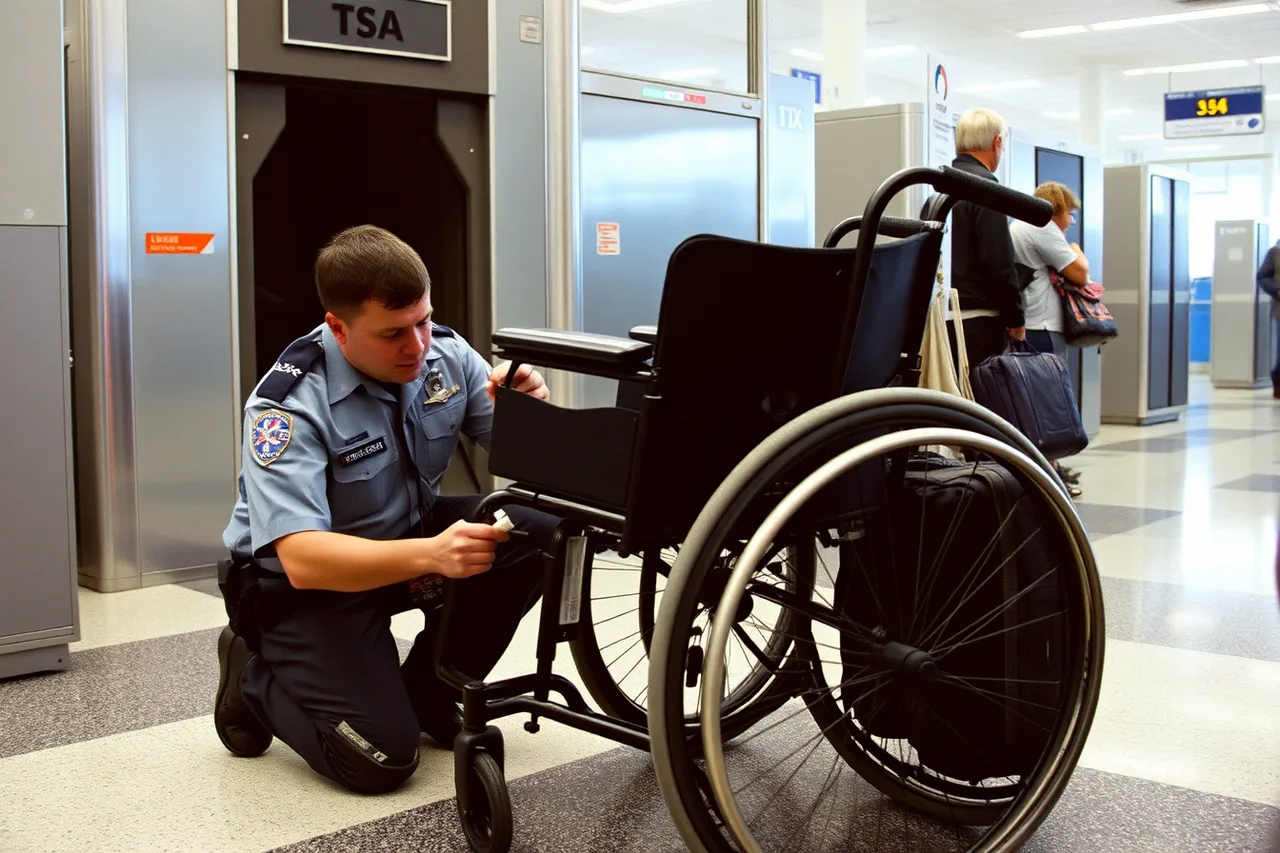
Expect a visual and physical inspection of the chair, a swab of the frame and wheels for trace explosives, and a pat-down if you cannot walk through the metal detector or the body scanner.
You may request a private screening area at any point, and you may request that a companion be present. You may not be required to remove a prosthetic limb, a medical device or a mobility aid. If a device cannot be screened by X-ray, officers must use an alternate method.
Manual wheelchairs usually pass through the X-ray tunnel after you transfer out; power chairs are inspected in place.
Limits on what officers may do
Officers may not ask you to remove clothing beyond a jacket, shoes or belt. They may not require you to disclose a diagnosis. They may not separate you from your mobility device for longer than the screening requires, and they must return it to you before you leave the area.
If a chair is disassembled for inspection, the officer who took it apart should put it back together.
Damage at the checkpoint is a real risk, particularly to joysticks, armrests and battery housings that get lifted or twisted. Watch what happens to the chair and note the officer's name or the lane number if you can. That detail decides which claim route you use later.
Filing a wheelchair damage complaint with the airline, step by step
Do this at the airport if you can. The longer you wait, the easier it is for a carrier to argue the damage happened after you left.
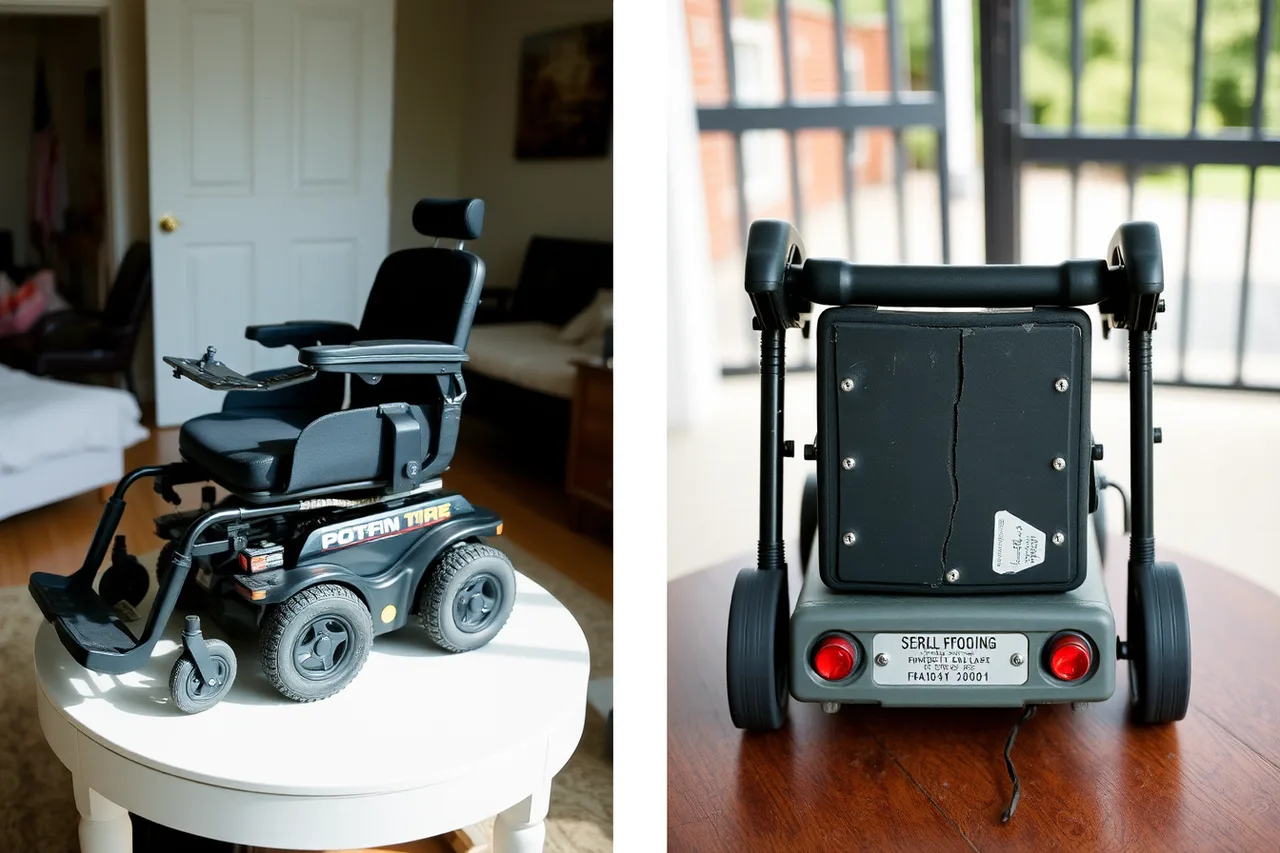
- Inspect the wheelchair at the gate, before you leave the jet bridge. Photograph every side, the serial plate and any new crack, bend or missing part.
- Report it to the airline's baggage service office in the terminal and ask for a Property Irregularity Report or a damage report. Get the file number in writing.
- Keep the gate-check tag, the boarding pass and the bag tag. These tie the device to the flight.
- Get a written repair estimate from a mobility dealer or a manufacturer's service center. If the chair is unusable, ask for a loaner and keep the rental receipt.
- Send a written complaint to the airline's disability or customer relations address within the deadline the carrier sets, and keep a copy.
- If the airline denies the claim or ignores it, file through the DOT Aviation Consumer Protection office's online air travel complaint form, selecting the disability complaint option. The Discrimination | US Department of Transportation page explains how disability complaints are filed and what the office can do.
What the airline owes you
For a domestic flight, the carrier is liable for the full value of a damaged mobility device, and the DOT treats a wheelchair as assistive equipment rather than ordinary baggage.
That means the usual domestic checked bag liability cap does not apply to the chair itself. The airline may repair the chair, replace it or pay a settlement. You are entitled to a loaner or a rental in the meantime if the chair is unusable.
Do not accept a first offer on the spot. Get the repair estimate first, then negotiate. If the chair is a custom power model, the replacement cost can run into five figures, and the airline's first number is rarely that.
Deadlines and how long it takes
Airlines set their own internal deadlines for damage reports, often within 24 hours for damage and seven days for delayed delivery on domestic trips. The DOT complaint route has its own window, generally six months from the incident for a disability complaint. Missing the airline's deadline does not kill the DOT route, but it weakens the case.
When the claim belongs with TSA instead of the carrier
If the chair was damaged during screening, before it ever reached the airline's hands, the carrier is not the responsible party. That claim goes to TSA. The Claims | Transportation Security Administration page covers the filing process, the forms and the proof TSA wants.
The split matters because the two systems have different standards. An airline is liable for the chair as assistive equipment. TSA is a federal agency applying the Federal Tort Claims Act, which has its own limits and its own deadlines. Filing with the wrong one costs weeks.
How to tell which route applies
Ask where the damage happened. If the chair left your hands at the gate in working order and arrived at the destination gate broken, the carrier had custody and the airline claim applies.
If an officer disassembled the chair at the checkpoint and it did not work afterward, or if a part went missing on the belt, TSA is the target.
When the facts are unclear, file both. A DOT complaint and a TSA claim can run at the same time, and each agency will tell you if it thinks the other one owns the matter.
Documentation that makes a damage claim stick
A claim is a records contest. The traveler with the better file wins, regardless of who was actually at fault. Build the file before you fly, not after.
Photograph the chair before every flight
Take dated photos of all four sides, the underside, the joystick or handrims, and the serial number plate. Photograph it again at the gate before you hand it over. A before and after pair is the single most persuasive exhibit in a wheelchair damage claim airline dispute.
Keep the paper trail in one place
- Gate-check tag and bag tag numbers
- Boarding passes for every leg
- The Property Irregularity Report number
- Names or lane numbers of any TSA officers involved
- Repair estimate and the dealer's contact details
- Receipts for a loaner, rental or taxi rides caused by the damage
- Copies of every email and letter you send
Write the complaint like a timeline
State the flight numbers, the dates, the device make and model, and what it did before and after. Attach the photos and the estimate. Ask for a specific remedy: repair at the airline's cost, replacement, or a stated sum. Keep it under two pages. Send it by a method that produces a delivery record.
A well-documented claim also protects the next traveler, because carriers track these reports. If you travel often, keeping a working device through repeated gate checks is its own discipline, and our notes on wheelchair accessible trips field cover the pre-flight checks that catch damage early.
Build the buffer into the trip
Allow a full day between arrival and any event that depends on your chair working. Carry the tools and spare parts your chair needs most, and know where the nearest dealer is.
For a longer trip, the sequence in planning a wheelchair accessible trip puts the equipment checks ahead of the bookings. The cost side, including what a replacement chair does to a budget, is worth reading before you book a carrier with a weak complaint record; our overview of wheelchair accessible trips sets out those figures.